


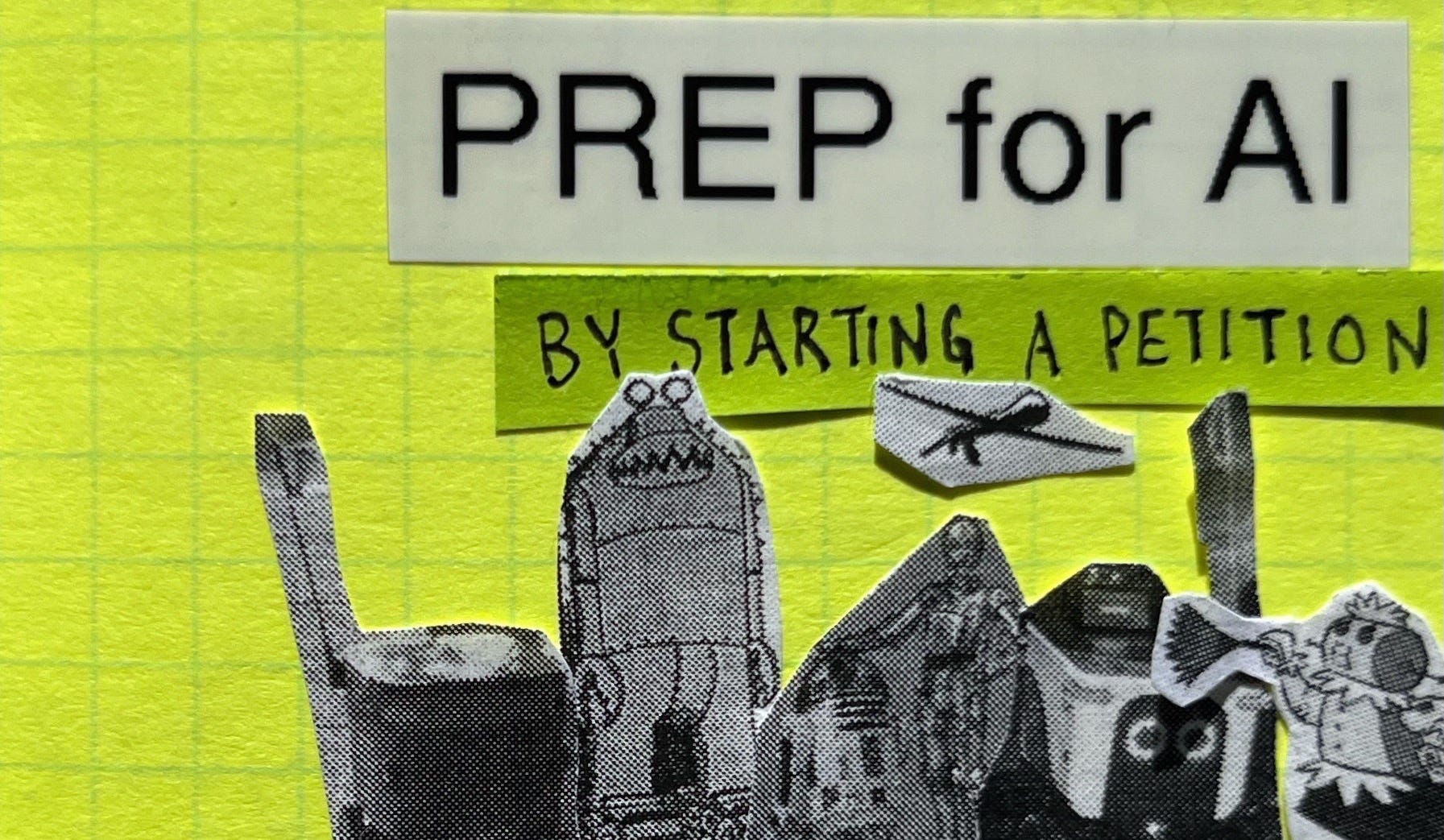
I didn’t plan to become the guy fighting robots. I’m a Star Wars fan. When I first spotted a delivery bot rolling down my street, my honest reaction was: Finally, droids are here. My pre-schooler waved at it from our apartment window. We were charmed.
That changed on a walk a couple weeks later. A robot came toward my family on the sidewalk — bright headlights, cameras scanning, flag bobbing. We stepped aside to let it pass. That’s what you do when something with wheels and a little momentum is headed at you. But this was a sidewalk. And something about yielding to a machine in the pedestrian space felt wrong.
I started asking questions. What are our sidewalks going to be like if these programs scale the way the companies want? What will it be like to go for a walk? Who decided to put these here, and did anyone ask us?
I couldn’t find many others even asking questions, let alone any good answers. So I started a petition.
Why it matters
The delivery robots on my sidewalk are the advance guard. Serve Robotics grew its fleet twentyfold in 2025, deploying over 2,000 robots across US cities.¹ Coco Robotics operates another 1,000, with ambitions to scale to thousands more.² These are well-capitalized companies executing a land grab in public space — city by city, through pilot programs most residents don’t know exist until the robots show up.
This is the pattern we’re going to see again and again as automation moves into the physical world. A company deploys. A city permits it quietly. Residents notice. And the question becomes: do regular people have any say, or does this just happen to us?
Civic action — the boring, local, analog kind — is the primary mechanism ordinary people have to govern how this stuff enters our lives. That’s the tactic.
What I tried
Last summer, I launched NoSidewalkBots.org — a petition asking Chicago to pause its sidewalk robot pilot until the city releases safety and ADA compliance data, evaluates that data and local job impacts in a public hearing, and establishes clear rules. Not “ban all robots.” Not “technology is evil.” Not “not in my backyard.” Just: slow down, show us the data, and let the public weigh in.
I built the site. Printed t-shirts. Handed out flyers. Posted on Reddit and Nextdoor. Here’s a detail that matters to me: the campaign is now entirely AI-free. I used AI for some aspects early on, but as the stakes got real, that felt increasingly hollow. The medium is part of the message. I haven’t used it once in many months, though it’s been tempting.
What happened
I was hoping for 100 names. I thought 250 by Thanksgiving would be a stretch goal. We crossed 1,000 on Thanksgiving Day.
The media found us before that, around 700 or 800 names — and here’s a detail I still can’t quite believe: the flyer that caught CBS Chicago’s attention wasn’t mine. Someone I’ve never identified printed a flyer with a QR code to my petition and taped it to a pole on their own.
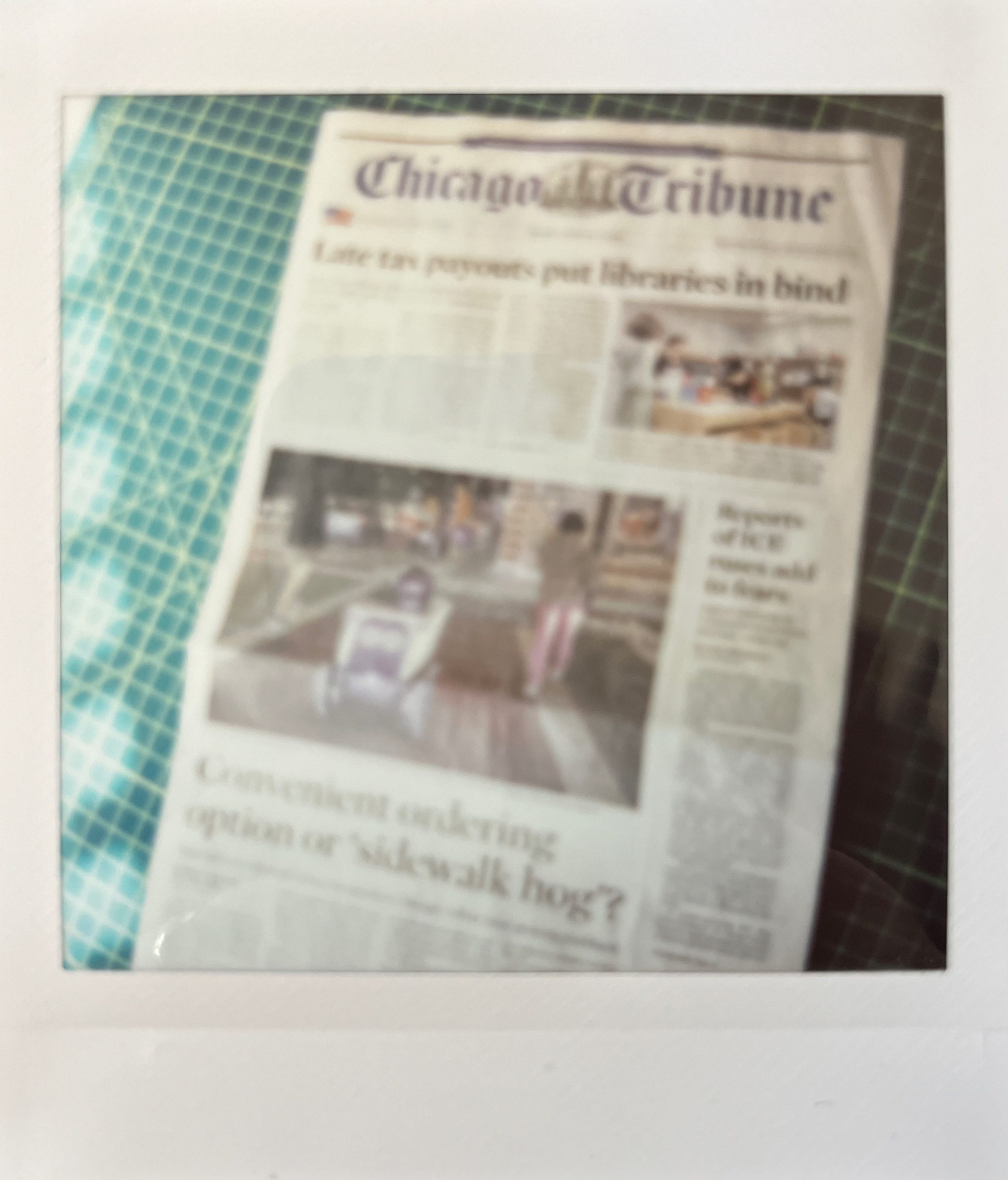
CBS broke the story on the evening news. Then it cascaded — Block Club Chicago, ABC7, NBC, WGN Radio, the Washington Times, Axios, Futurism. A second wave hit in February: the Chicago Tribune ran it on the front page, Fast Company published a feature that led to an NPR All Things Considered segment, and the Economist covered it.
As of this writing, more than 3,600 people across 55-plus Chicago zip codes have added their names. Over 900 have used the incident field. The stories are sobering: a man who needed stitches and a tetanus shot after colliding with a robot’s visibility flag while catching a bus. Children hit. Feet run over. A blind man with a seeing-eye dog unable to get past a robot on a narrow sidewalk. A Chicago Fire Department paramedic reporting standoffs with robots while driving to emergencies. Wheelchair users describing sidewalks made unnavigable. Robots repeatedly driving at groups of kids, stopping inches away. Near-constant beeping audible from third-floor apartments. A woman followed by a robot displaying heart eyes on its screen.
Elected officials took notice. Multiple alderpersons began surveying their own constituents after the petition gained attention. In December, the city added a robot-specific complaint category to 311. In February, Alderman La Spata held a community meeting and surveyed his ward — more than 83% strongly opposed the robots’ expansion — and moved to block further deployment. I don’t know exactly how much our petition caused versus surfaced, but I’ve been proactive: reaching out to alderpersons’ offices, sharing data, visiting my own alderman’s office for a sit-down with staff. This is what civic engagement actually looks like.
I thought people would divide along the usual lines — tech-optimists vs. Luddites, young vs. old. They didn’t. Parents, wheelchair users, dog walkers, bike couriers worried about their jobs, elderly residents. The unifying thread wasn’t anti-technology sentiment. It was a shared conviction that public space belongs to the public.
Should you bother?
If you don’t have delivery robots on your sidewalks yet, you probably will soon. And the pilot coming to your town might not be sidewalk bots — it might be AI-powered surveillance cameras, facial recognition at your kid’s school, or something nobody’s thought of yet. The pattern is the same.
The tactic isn’t “start a petition about robots.” It’s: pick one concrete issue where AI or automation is entering your community, your workplace, or your life in a way that feels questionable — and do something about it. The hardest part hasn’t been putting my name on something public. It’s been feeling my way through what has become organizing, having never done it before.
It was also the most energizing thing I’ve done in years. In a moment when most of us feel like AI is something happening to us, this was a reminder that we still get a vote. Not a metaphorical vote. An actual civic voice.
You have one too. Use it.
This is the first field report from Prep for AI — a public experiment where I test one practical tactic at a time and report what happens. If you want to follow along, subscribe. Next up: I’m auditing my own job for AI exposure. The results are uncomfortable.
I use AI (Claude by Anthropic, at the moment) to help produce this newsletter. More on how and why on the Framework & Transparency page. The NoSidewalkBots campaign, however, is entirely AI-free — by deliberate choice.
Your turn: Has AI or automation shown up in your community — on your sidewalks, in your schools, in your workplace, in your local government? I’d love to hear about it. Reply to this email or leave a comment. And if you think I’ve framed something wrong here — about the robots, about civic action, about any of it — tell me. I’m an amateur running experiments, not an expert handing down wisdom. The whole point is to get smarter together.
The tactic, rated:
⏱️ Time required: A few hours to launch; ongoing (a couple hours a week to maintain)
🔧 Difficulty: Moderate — you need a clear ask, a simple website, and the willingness to put your name on it
😬 Discomfort level: High — this is public, in your real community, with real stakes
💪 Resilience payoff: Very high — civic muscle is the primary check on how AI enters your life
Sources:
Serve Robotics. “Serve Robotics Builds 2,000 Autonomous Delivery Robots, Creating Largest Sidewalk Delivery Fleet in the U.S.” Press release, December 12, 2025.
Grush, Bern. “From Cute to Contested: How Public Acceptance of Sidewalk Delivery Robots Has Changed.” Urban Robotics Foundation, March 11, 2026.
Changelog:
v1.0 — 03.17.2026 — Initial post.
v1.1 — 03.19.2026 — Clarified that NPR's All Things Considered interviewed the Fast Company author (not a syndication of the article).